What is Earth Overshoot Day?
Overshoot Day views the Earth’s resources from the perspective of a supply and demand equation.
The “supply side” of the equation refers to the Earth’s total biocapacity to respond to our needs – the amount of resources it can provide and the amount of waste and emissions it can absorb. As such, forests, fields, lakes, and seas play a very critical part in determining earth’s biocapacity.
The “demand side” refers to humanity’s environmental footprint — how many of us there are, how much we consume, and how efficiently we make products we use every day. Overshoot, then, means the ecological deficit created when our demands exceed the available supply of natural resources.
So, if Earth Overshoot Day marks the point when humanity’s demand on nature exceeds what the planet can regenerate in a year, why is it so important? Well, the consequences of exceeding this limit include deforestation, soil erosion, biodiversity loss, and the accumulation of carbon dioxide in the atmosphere, leading to more extreme weather events as well as constraints on food production, and so much more!
So, what are 6 top-line takeaways from Earth Overshoot Day 2025?
1. Heard of the Pleistocene Epoch…how about the Anthropocene?
From climate change to species loss and pollution, humans have etched a stunningly powerful impact on the Earth since the middle of the 20th century. So much so, in fact, that a special team of scientists describes it as the beginning of a new geologic epoch. Called the Anthropocene — and derived from the Greek terms for “human” and “new” — this epoch started sometime between 1950 and 1954, by their calculations.
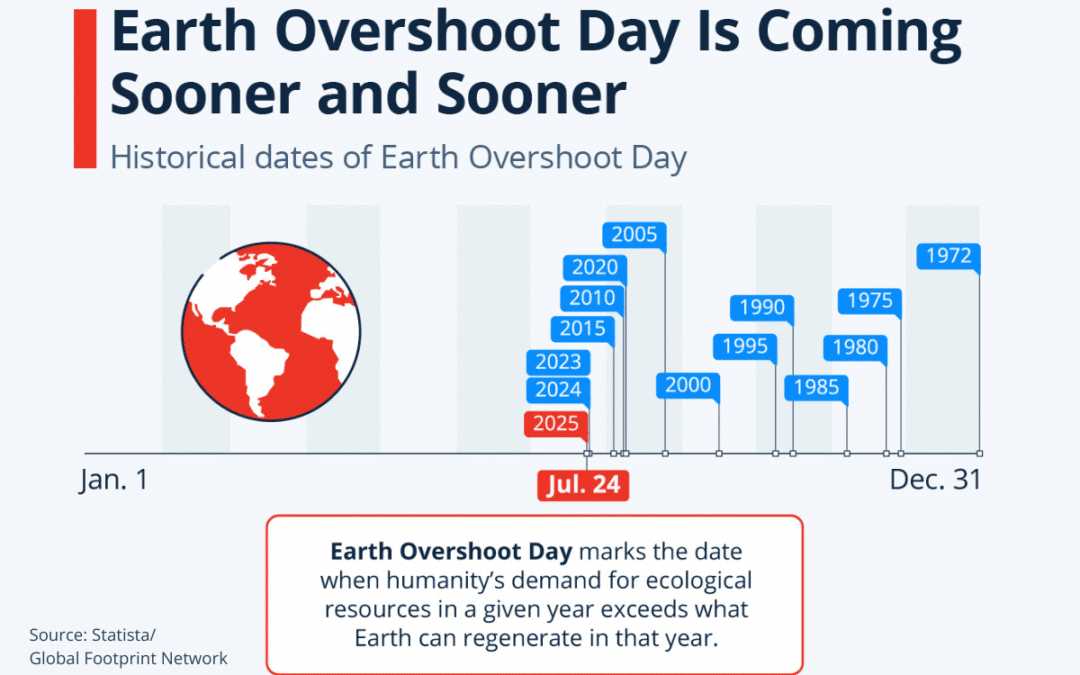
During this time, human activity has had a defining impact on the planet’s climate and ecosystems: The ecological and carbon footprint of humans has dramatically increased, while Earth’s bio-capacity (the sum of natural resources it can regenerate, plus the waste it can absorb within a year’s time) has diminished significantly. That has led to Earth Overshoot Day arriving earlier and earlier each year, moving from December 30th in just 1970 to July 24th in 2025!

2. Earth Overshoot Day 2025 reflects that we’re just living off credit!

In the first 7 months of 2025 (that’s this January to July), humanity has already consumed all the resources the planet can replenish within 12 months! In other words, our final five months of the year will burn into resources that — with no Planet B — we simply cannot afford. We are now literally living “on credit,” and it would currently take 1.75 Earths to meet the needs of the world’s population for this time period.
As the second chart indicates, Chinese living standards would use up 2.4 Earths. Most major industrialized nations in Europe and Asia would consume between 2.6 and 4.8 Earths if their lifestyle was universal. Similarly, if the entire planet mirrored the average US lifestyle, then we would need 4.9 Earths to satisfy the yearly global resource demand.
According to the Global Footprint Network, Qatar, Luxembourg and Bahrain are even bigger offenders than the U.S.: If the whole world were to adopt these countries’ lifestyles, consumption would be estimated at between 5.4 and 8.7 Earths per year. Yet, thanks to their relatively small population size, they each play a lesser part in global resource depletion than larger countries like the U.S.
3. Countries in the developed world carry the most responsibility.
This year’s country overshoot dates, released by the think tank Global Footprint Network, reveal a pretty daunting prospect. Not only do they show the extent to which we are over-extracting the planet’s resources, but they also underline the extreme inequalities that exist between countries.
Our chart shows that Qatar, a relatively small and rich country, is a main offender for burning through resources the fastest. In fact, if the whole planet consumed resources at the pace of Qatar, we would have hit our 2025 threshold by February 6. At the other end of the spectrum comes Uruguay, with its overshoot day in December. The consumption divide seems to be split between richer, industrialized countries and those with a lower income.

4. One earth is more than enough for some, but not for others!

Finally, around 50 countries do not overextend their natural resources and therefore do not have an Earth Overshoot Day! For example, in India, the equivalent of 0.7 Earths is used annually. If everyone lived like the inhabitants of these countries highlighted on our map, who use up less than their allotment of resources, then one Earth would suffice to meet the needs of humanity. Unfortunately, these very same countries are also the ones that are now most threatened by the adverse impacts of climate change!
The concept of Earth Overshoot Day was first conceived by Andrew Simms of the UK think tank New Economics Foundation, which partnered with Global Footprint Network in 2006 to launch the first global Earth Overshoot Day campaign. Emissions, but also the use of resources like wood, fish and crop land are among the factors used to calculate Earth Overshoot Day statistics. To find out more about the calculations behind Earth Overshoot Day, please click here.
5. A good question on Earth Overshoot Day would be – If you were aboard a spaceship, how carefully would YOU maintain YOUR life-support system?
We are currently facing a negative overshoot trend, and the reasons for it are absolutely clear:
a) Increasing global population and consumerism (the idea that individual well-being and happiness depend on obtaining material possessions) is causing us to consume and produce more and more goods
b) Natural ecosystems are increasingly diminishing as they get repurposed for our agricultural, industrial or residential needs.
Even worse, all of this accelerates climate change, which in turn contributes to further loss of natural ecosystems. So you can see — we have an urgent need to maintain and nurture our planet’s health so it can support us now and in the future. To do this, we must reinforce our life-support system while reducing social demand. A sensible mantra for creating a sustainable future should be: Nurture Nature and Control Consumption.

6. Earth Overshoot Day 2025 reminds us every day should be Earth Day!
Nurture Nature: Conservation, Restoration & Regeneration
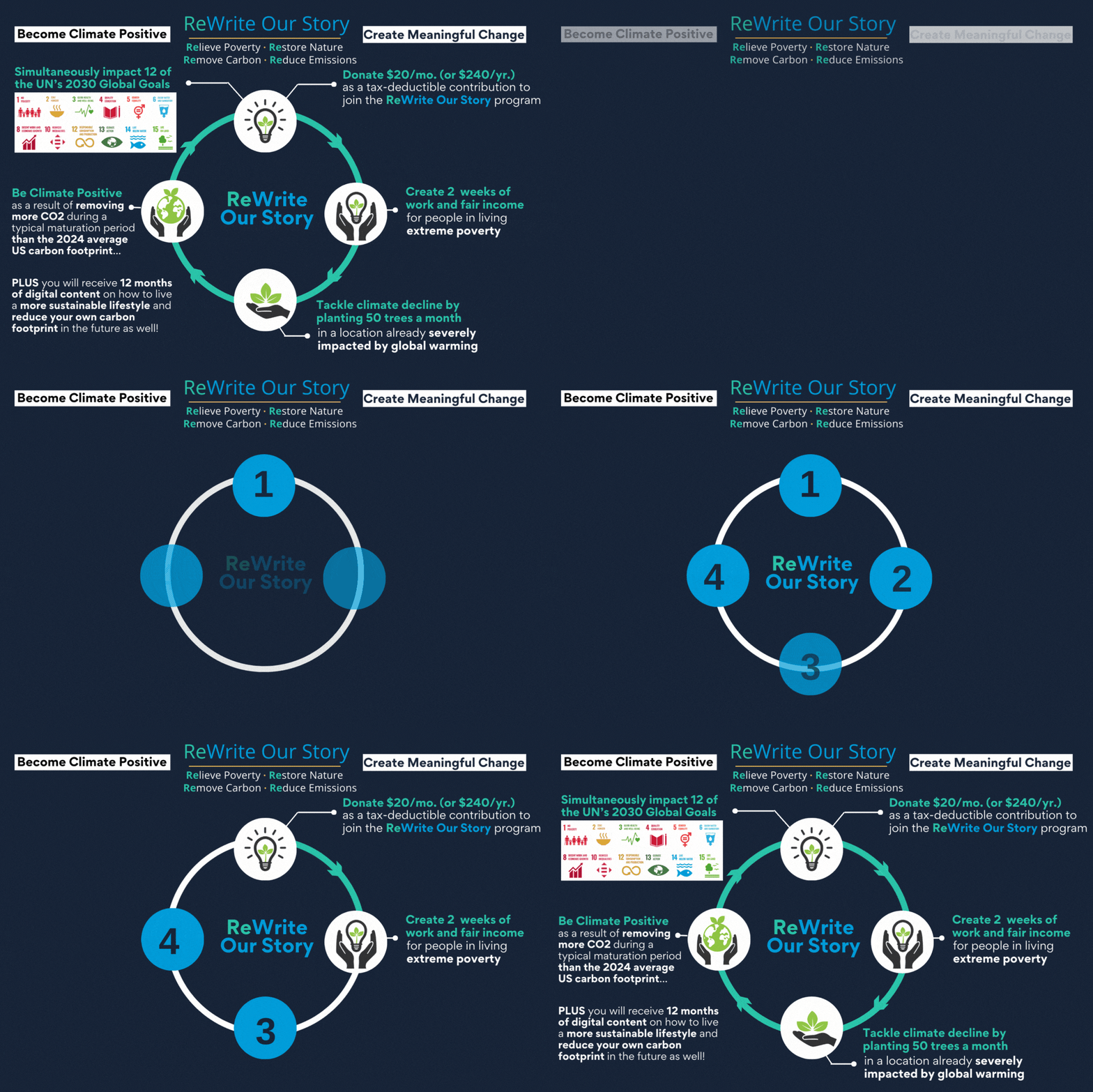
The good news is, solutions already exist to boost the health of our ecosystems and strengthen our planet’s capacity to regenerate biological resources. For example, just restoring forests could move the date of Overshoot Day by 8 days, AND if we move the date by just 6 days each year, humanity can be out of overshoot before 2050!
Plus, an investment in reforesting our tropical forests and mangroves delivers a triple benefit: it increases biodiversity, sequesters carbon dioxide, and forms a flood barrier for coastal areas.
If this approach sounds appropriate, you can even click here to support this Blue Carbon solution and also offset your carbon footprint for $20 a month. In addition, you’ll get a free monthly series on how you can amend your own consumption habits and lower your carbon footprint in the future as well!
Control Consumption: Move Beyond “Take-Make-Waste”
Our future mindset should focus on fulfilling the needs of society without creating disproportionate waste or consumption. To achieve this more sustainable state, we need to embrace 3 core principles:
Efficiency: Better usage of resources so that goods get produced using less energy and fewer resources.
Consistency: Linear production must be replaced by a Circular Economy, which minimizes waste by facilitating repair and reuse.
Sufficiency: A shift in the perception of prosperity which links personal well-being to a pattern of more measured resource consumption versus unconstrained growth.
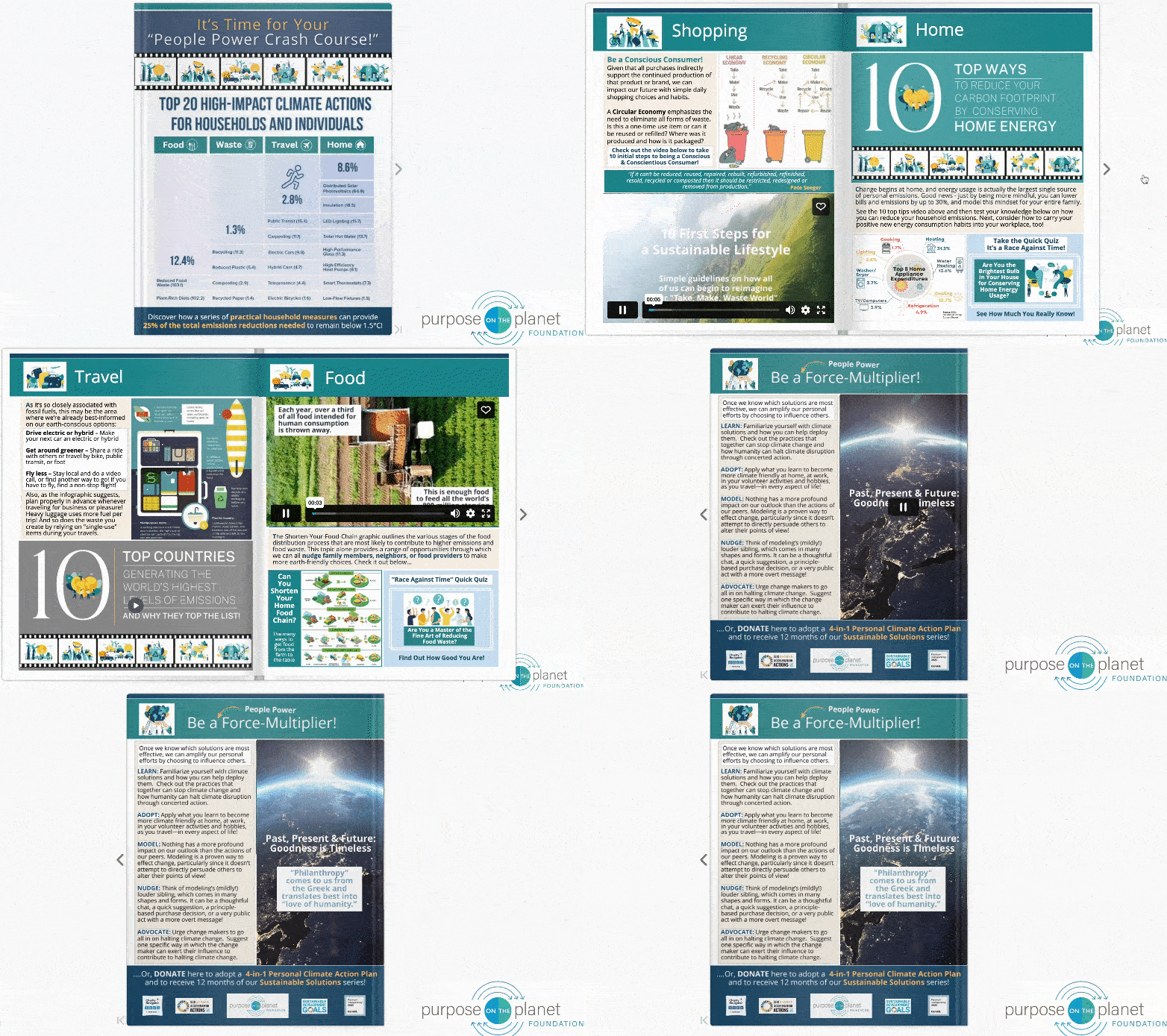
If you’re inspired to help move our future Earth Overshoot Day dates, here are three different programs you could adopt to “Nurture Nature”, as they all directly support restoration, conservation and regeneration!

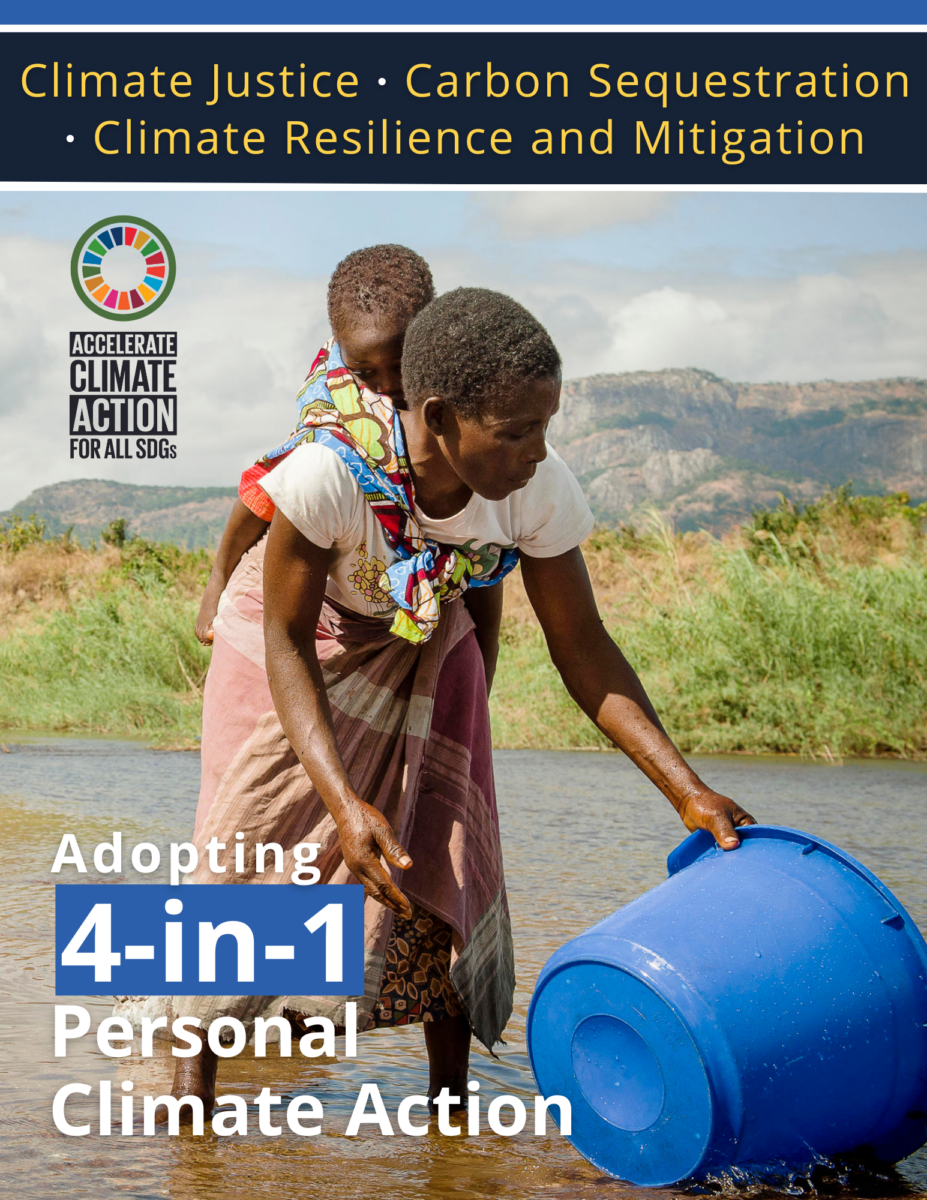
View an Interactive Playbook on How a Climate Change Donation Creates 4-in-1 Climate Action


See an Interactive Impact Report on How Environmental Donations Transform Lives & Livelihoods


Explore an Interactive Version of “The Climate Positive Carbon Footprint Offset Program”