
Can we REALLY offset our carbon footprint through planting trees and, if so, how many? • How do we identify the best carbon offset companies & tree planting organizations? • How can we know that best restoration practices are being followed when we support carbon offset tree planting? • What types of forestry programs are most effective for carbon sequestration?
Forestry and restoration programs are popular options for environmentally-minded individuals who want to take action on their concerns about nature, climate change — and even how to offset their own carbon emissions. However, it can be tough to make an informed decision on what are the best carbon offset companies or which tree planting organizations most deserve your support …Partly because there aren’t a lot of educational resources out there that draw important distinctions among available environmental causes!
This is why, since 2020, Purpose on the Planet has worked diligently to refine a 5-point criteria framework for identifying project locations and programs that are best set up to optimize long-term planting and sequestration success. Which brings us to PLANT! –It’s our acronym for delivering the highest-quality ROI on every donor dollar spent for forest conservation and carbon offset tree planting:
Planting • Longevity • Affordability • Nature’s Numbers • Trees & CO2
PLANTING: Which forestry approaches do the best carbon offset companies and tree planting organizations adopt in their programs?
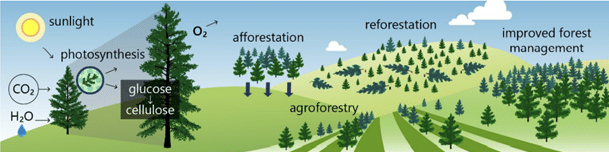
You may be surprised to learn that forestry projects focused on carbon offsets tend to fall into one of five main categories:
1. Reforestation restocks existing forests that have been depleted through activities like logging
2. Afforestation introduces trees to create new forests in previously unforested areas
3. Agroforestry purposefully integrates trees into agricultural areas
4. Improved forest management (IFM) aims at increasing forests’ carbon stores by delaying or avoiding timber conversion
5. REDD+ (Reducing Emissions from Deforestation and Forest Degradation) aims to preserve intact forests by avoiding commercial conversion
Of the above, only project types 1-3 focus directly on planting and incremental removal of the CO2 that already exists in the atmosphere. In contrast, types 4-5 involve activities to avoid and reduce emissions without clear accounting of removal.
LONGEVITY: How can we be assured of the durability of a forestry project?

Three central considerations come into play when ensuring durability and permanence of any tree planting and forest conservation project:
Community-based Conservation – This proven strategy engages communities in the preservation, protection, restoration, and management of their own local ecosystems. Traditionally, indigenous peoples have defended against deforestation out of fear that it will compromise the quality of their lives and livelihoods. Conversely, when we can get those local communities on-board with the idea of conservation, plus actively involved in program execution, we transform them into empowered believers and guardians.
Legal Title – Secure community ownership rights are essential for sustainable forest management, and they can prompt local communities to willingly participate in planting and conservation efforts. The best carbon offset companies and tree planting organizations will invest considerable time and energy at the outset of any project to verify, or even facilitate, the appropriate ownership rights for local communities. Having legal title empowers them to protect their land and the livelihoods it offers, while minimizing the potential for deforestation. It can also open the door for future carbon-market revenue streams resulting from its management of emerging forests and continued sequestration.
AFFORDABILITY: How can we plant & sequester CO2 most economically?
“Trees per $10” – What do you mean? -…Well, once the above core foundations have been laid, a very simple way to assess value for money is to determine how many trees can be planted for every $10. As a 2025 guideline, many providers advise that 5 or 10 trees can be planted for $10, or 1 tree for every $1 or $2.
So far, so good. But what if you could plant 20 or 25 trees for the same $10? That’s twice (or even 5 times!) as many trees for every $1 investment! If you identify the right tree planting organization or carbon offset tree planting program, it’s also feasible to do so without diluting any best practices — bonus!

Nonprofit Efficiency– Simply put, this term refers to how effectively a nonprofit uses its resources to achieve its mission and meet its goals. For example, if a non-profit is 100% “founder-funded” and/or volunteer-run, it can minimize its own operating expenses and dependence on extra, third-party intermediaries. So, the actual cost for planting a tree need not be unduly inflated (or even increased at all!) to support salaries and other operational overheads that are not directly linked to the planting process itself. We’re living in an increasingly purpose-driven society, and this contemporary nonprofit model can assist in significantly multiplying your philanthropic and environmental impact.
NATURE’S NUMBERS: Which metrics do the best carbon offset companies & tree planting organizations track to ensure optimal restoration results?
MRV – Measurement, reporting, and verification are the keys to lasting restoration success. Data collection helps boost best practices, increases long-term outcomes, and enhances the overall survival rates at planting locations. …And all of this monitoring can be done most efficiently and economically by community-led Forest or Tree Growing Associations. In fact, don’t be surprised to hear that they leverage modern technology such as drones and satellite imagery!

Survival Rates – Well-established projects often identify and call on local Tree Monitoring Champions from within the community to lift program results. These community members are charged with tree-stand management and data collection, as well as post-planting activities like weeding, watering, pest management, and wildfire protection. For example, in one of our Tanzania locations, this formula has helped achieve a planting survival rate in excess of 85%. The latter is a vital metric for assessing project outcomes as a whole, and it’s all the more important for carbon offset tree planting programs and offsetting carbon footprint, since sequestration levels rise as new trees continue to mature.
TREES & CO2: Which tree species sequester most CO2? How many trees do best carbon offset companies plant to offset an average carbon footprint?
CO2 – A reliable per-hectare estimate of carbon sequestration can only be obtained from Permanent Sample Plots — all of them reasonably large and well managed stands of trees.
That said, tree planting organizations and carbon offset companies with a strong commitment to success metrics and longevity may well have already established CO2 sequestration levels at their site, or conducted their own Quantified Carbon Modeling (QCM) assessment. Once this carbon offset tree planting data has been established, it’s possible to arrive at the average figure of CO2 sequestered per hectare per year for a particular location and tree species.

Target – US per capita CO2 emissions in 2025 are estimated by Statista to be 13.5 metric tons. For the purposes of this article, we will round this figure up and focus on how many new trees it would take to capture around 14 tons of CO2 during a typical maturation period, using QCM data from Madagascar.
This 2024 reporting was generated at one of our community-based mangrove reforestation projects in Madagascar and, as outlined above, made appropriate adjustment for (a) planting density per hectare; and (b) current survival rates.
The conclusion was that planting 600 mangroves (or 50 trees every month in a year) would remove 14 metric tons of CO2 during a typical maturation period.
As Purpose on the Planet is a founder-funded nonprofit, $10 will plant 25 trees in both of our locations in Madagascar and Tanzania, so donating $240 (or $20 a month in a year) will plant 600 trees and remove more CO2 than is emitted in a year by an average US resident.
Every donation of $240 (or $20 a month) for carbon offset tree planting at the community-based projects we support will create ALL THREE of the humanitarian & environmental outcomes below:

Two Weeks of Work & Income for Villages-in-Need to Plant 600 Trees

See an Interactive Impact Report on How Environmental Donations Transform Lives & Livelihoods

A Holistic 4-in-1 Climate Change Action Strategy for People & Planet
View an Interactive Playbook on How a Climate Change Donation Creates 4-in-1 Climate Action

More CO2 Sequestered than an Average US Person Emits in a Year

Explore an Interactive Version of “The Climate Positive Carbon Footprint Offset Program”