Deploying Five Invaluable Benefits of Mangroves
Discover how mangrove ecosystems help protect our climate, coastlines, biodiversity, water and the livelihoods of communities around the world.
Climate guardians
living shields
forests that feed families
nurseries of life
nature’s water filters

Discover the five superpowers of one of nature’s great multi-taskers
At first glance, a mangrove can look like an ordinary tree growing in a very unusual place. But that is precisely what makes mangroves and mangrove ecosystems extraordinary.
They belong to a remarkable group of trees and shrubs able to survive where land and sea collide—in salty, oxygen-poor, waterlogged environments that most trees simply cannot tolerate.
And by thriving at the intersection of land, freshwater and ocean systems, mangroves have evolved into some of nature’s most valuable multitaskers.
Mangrove forests quietly perform five extraordinary services for people and planet and the unique benefits of mangroves can be witnessed from tropical coastlines in Asia and Africa to the Americas and the Pacific.
They capture and store carbon, protect vulnerable coastlines, support food security and livelihoods, provide essential wildlife habitats, and help maintain the quality of surrounding coastal waters.
These five interconnected benefits help explain why mangroves are among the world’s most valuable—and increasingly threatened—ecosystems.
Here are the five mangrove superpowers that make them so important.
What are the five key natural benefits of mangroves?
Mangroves are important because they connect land, freshwater and marine ecosystems while providing essential benefits to both nature and people.
These contributions are known as ecosystem services —the benefits that healthy natural systems provide to society.
And what makes mangroves particularly extraordinary is that a single forest can deliver many of these benefits simultaneously.
Mangrove ecosystems provide five interconnected environmental and social benefits. They serve as:
Climate Guardians: Capturing and storing carbon in trees and waterlogged soils.
Living Shields: Helping protect coastlines from waves, erosion and flooding.
Forests that Feed Families: Supporting food security, livelihoods and opportunities for local communities.
Nurseries of Life: Providing essential habitat for fish, crustaceans, birds and other wildlife.
Nature’s Water Filters: Trapping sediments and helping protect coastal water quality.
Together, these mangrove ecosystem benefits support climate resilience, biodiversity conservation and the well-being of coastal communities worldwide.
discover all the benefits of mangroves In one minute
And because mangroves connect terrestrial, freshwater and marine environments, their importance extends far beyond the boundaries of the forest itself.
Key Benefits of Mangroves #1: Climate Guardians
Why mangroves are extraordinary natural carbon stores


Mangroves are remarkable natural carbon-capture and storage systems.
Like other trees, they absorb carbon dioxide from the atmosphere through photosynthesis, storing carbon in their trunks, branches, leaves and roots.
But their greatest climate superpower often lies beneath our feet.
Mangrove forests grow in waterlogged soils where limited oxygen slows the decomposition of organic matter. As leaves, roots and other plant material accumulate, carbon can become buried in sediments and remain stored for centuries or even thousands of years.
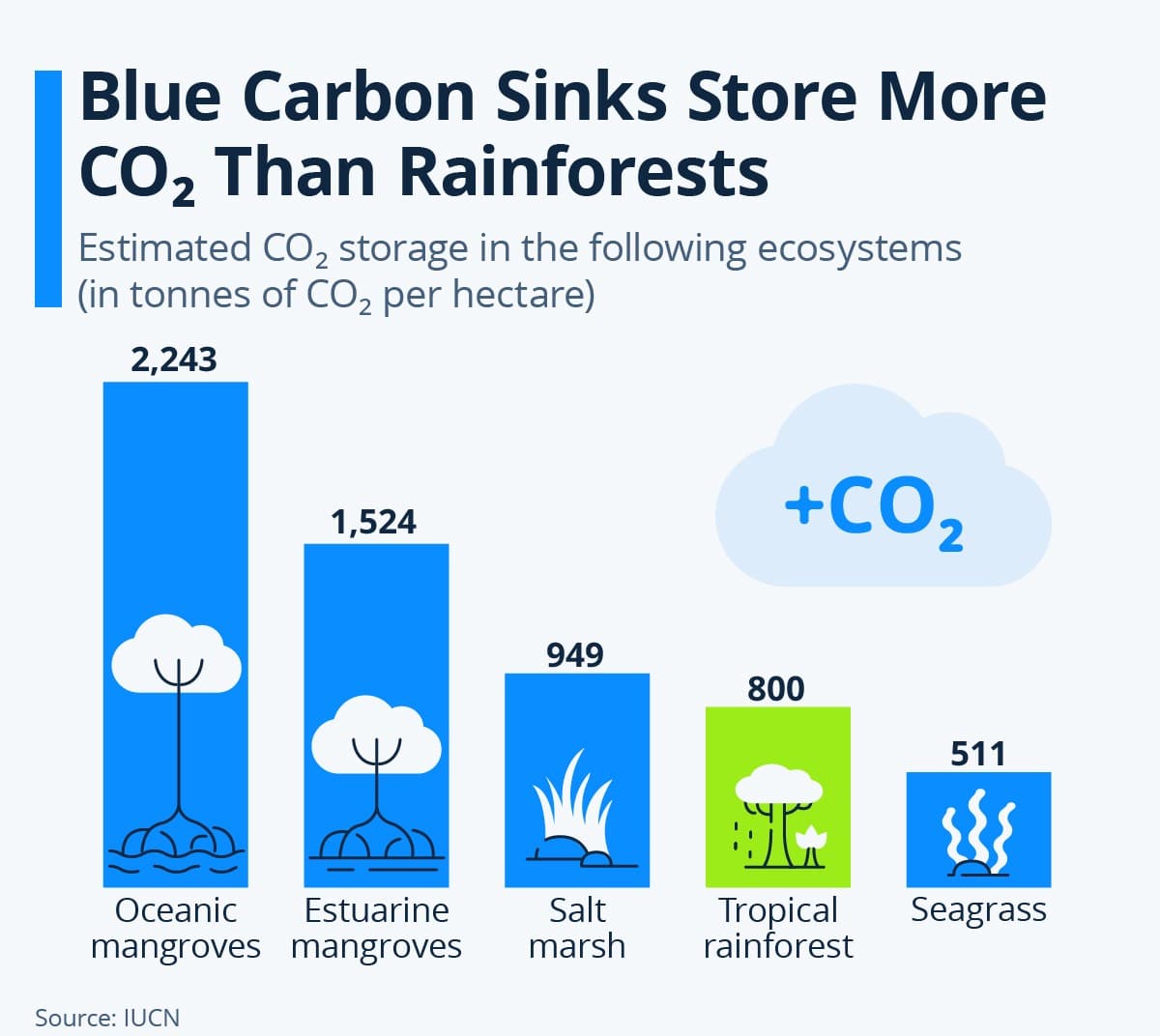
This is part of what scientists call blue carbon—carbon captured and stored by coastal and marine ecosystems, particularly mangroves, salt marshes and seagrass meadows.
According to the National Oceanic and Atmospheric Administration (NOAA), mangroves and salt marshes can store approximately three to five times more carbon per acre than tropical forests, with much of that carbon held in their soils.
The precise amount varies with location, forest condition, soil depth and the methods used to measure carbon stocks.
Importantly, carbon storage and carbon sequestration are not the same thing.
Carbon storage describes how much carbon is already held within an ecosystem. Carbon sequestration describes the process of capturing and accumulating additional carbon over time. Healthy mangrove forests are extremely effective in contribute to both!
Why Protecting Existing Mangroves Matters
When mangroves are cleared or their soils are disturbed, some of the carbon accumulated over long periods can be released back into the atmosphere.
Protecting established mangrove forests therefore helps safeguard existing carbon stores, while restoring degraded areas can create opportunities for additional carbon accumulation as the ecosystem recovers.
The Climate Superpower:
Mangroves help address climate change by capturing carbon, storing it in vegetation and soils, and protecting carbon-rich coastal ecosystems from further degradation.
Key Benefits of Mangroves #2: Living Shields
How mangroves protect coastlines from waves and erosion
Along vulnerable coastlines, mangroves provide something remarkable: a living form of coastal protection.
Their dense networks of trunks, roots and vegetation create resistance as waves and tidal waters move through the forest.
This can reduce wave heights, slow water movement, trap sediments and help stabilize shorelines.
Unlike a concrete seawall, a healthy mangrove ecosystem also provides habitat, stores carbon and supports local livelihoods.
The strength of this natural protection depends on several factors, including forest width, vegetation density, water depth, incoming wave conditions and the shape of the surrounding coastline.
A 2025 peer-reviewed study published in Communications Earth & Environment examined wave attenuation across mangrove forests using extensive numerical modeling.
The researchers found a median reduction in wave height of approximately 90% across 500 meters of mangrove forest under the modeled conditions.
They also emphasized that actual performance varies significantly with local conditions, especially in narrower forests.
While this does not mean every mangrove forest will reduce waves by 90%, or that mangroves alone can eliminate the risks of all major coastal storms, it demonstrates how powerful healthy coastal ecosystems can be when conditions allow them to function effectively.
Coastal Protection Is Also Community Protection
For people living along vulnerable coastlines, these ecological benefits can become profoundly human ones.
Reduced wave exposure and erosion can help protect homes, farmland, infrastructure and the natural resources on which communities depend.
Instead of building another wall between people and the ocean, sometimes one of our most valuable forms of climate resilience is a living ecosystem.
The Coastal Protection Superpower:
Mangroves can help reduce wave impacts, stabilize shorelines and strengthen coastal resilience—while delivering environmental benefits that engineered barriers cannot provide on their own.


Key Benefits of Mangroves #3: Forests that Feed Families
How mangroves support food security and coastal livelihoods


This may be the superpower that most clearly connects healthy ecosystems with human well-being.
For millions of people living along tropical coastlines, mangrove forests are far more than a natural landscape. They’re an important part of the systems that provide food, income and economic security.
Mangrove ecosystems support fish, shrimp, crabs and other marine species that sustain local and commercial fisheries.
They also provide natural resources used by coastal communities, although harvesting must be managed sustainably to protect the forests themselves.
According to the Global Mangrove Alliance, mangroves contribute to fisheries and livelihoods around the world, demonstrating how closely coastal economies are connected to healthy ecosystems.
When mangrove forests disappear, communities can lose more than trees. They may also lose valuable habitat, natural resources and some of the ecological support on which local livelihoods depend.
Conversely, protecting and restoring mangroves can help sustain the natural foundations of food security and economic opportunity.
The Livelihood Superpower:
Healthy mangrove ecosystems help sustain fisheries, provide natural resources and support the food security and livelihoods of coastal communities.
Key Benefits of Mangroves #4: Nurseries of Life
Why mangrove ecosystems are vital for marine biodiversity
Look beneath the water around mangrove roots and another world appears.
The submerged root systems of mangrove forests create sheltered spaces where juvenile fish, shrimp, crabs and other marine organisms can feed, grow and find protection from predators.
These habitats are often described as nature’s underwater nurseries.
Above the water, mangrove branches and canopies provide habitat for birds, insects, reptiles and mammals.
And beneath the surface, their sediments support microorganisms and invertebrates that help sustain the wider food web.
Mangroves are therefore not simply collections of trees. They are complex living ecosystems connecting life on land and beneath the water.
The [Global Mangrove Alliance](https://www.mangrovealliance.org/mangrove-forests) reports that mangrove forests provide habitat for at least **341 threatened species worldwide**.
That figure refers to species associated with mangrove habitats globally—not to species documented at any one restoration site.
Why Mangrove Biodiversity Matters Beyond the Forest
Mangroves often form ecological connections with neighboring seagrass beds, estuaries, mudflats and coral reefs.
Species may move between these habitats during different stages of their life cycles, while nutrients and organic matter circulate through the wider coastal environment.
Damage to mangroves can therefore affect ecological relationships extending beyond the forest itself.


Key Benefits of Mangroves #5: Nature’s Water Filters
How mangrove ecosystems help protect coastal water quality


The extraordinary tangle of mangrove roots performs a quieter—but equally valuable—service.
As tidal waters move through mangrove forests, trunks and roots slow the flow and encourage suspended sediments to settle.
Mangrove soils and vegetation can also retain nutrients and certain pollutants, helping influence the movement of materials between land and sea.
This natural filtration function can reduce the amount of sediment reaching nearby marine habitats, including seagrass beds and coral reefs.
Excessive sediment can reduce light availability and interfere with the health of sensitive underwater ecosystems.
By trapping and stabilizing sediments, mangroves can help protect the conditions these habitats need to thrive.
A Natural Filter—Not a Substitute for Pollution Control
Mangroves are remarkably effective at interacting with sediments and nutrients, but they are not conventional water-treatment plants.
Their ability to retain pollutants varies with local conditions, and excessive pollution can harm the mangrove ecosystem itself.
Protecting water quality therefore requires both healthy natural ecosystems and responsible management of pollution at its source.
They’re not simply growing beside the ocean. They’re part of the natural system helping protect the waters on which marine life and coastal communities depend.
The Water-quality Superpower:
Mangroves slow water, trap sediments and help maintain the ecological connections that support healthier coastal waters.
Why protecting mangrove ecosystems matters more than ever
For all their extraordinary benefits, mangrove ecosystems face growing threats.
Coastal development, land conversion, pollution, altered water flows and climate change can damage or destroy the forests that support so much coastal life.
In its first global assessment of mangrove ecosystems, the International Union for Conservation of Nature (IUCN) found that approximately half of the mangrove ecosystems assessed were at risk of collapse.
This matters because losing mangroves can mean losing several vital natural services at once.
A disappearing forest may release stored carbon, weaken coastal protection, reduce wildlife habitat and undermine resources important to coastal communities.
Protecting existing mangroves helps preserve these interconnected benefits.
And where ecosystems have been degraded, carefully planned restoration can help recover their natural functions over time.
But successful restoration requires more than planting trees. It depends on suitable ecological conditions, community participation, protection and long-term stewardship.
see Why Protecting Mangrove Ecosystems is so vital for us all today

The Global Mangrove Alliance’s Best Practice Guidelines for Mangrove Restoration emphasize these principles as foundations for successful ecological recovery.
Ultimately, protecting mangroves isn’t about saving one type of tree.
It’s about safeguarding an extraordinary network of natural benefits on which both people and planet depend.
Five superpowers. One ecosystem. Lasting impact.

We’re not simply talking about five separate environmental benefits. We’re talking about one extraordinary ecosystem capable of delivering all five.
A mangrove forest can capture and store carbon while protecting coastlines. Its roots can provide shelter for marine life while trapping sediments. Its biodiversity can support fisheries, food security and the livelihoods of coastal communities.
And because these benefits are interconnected, protecting one healthy mangrove ecosystem can help sustain an entire network of services for people and planet
At Purpose on the Planet, we’re helping put these extraordinary natural abilities to work through community-based mangrove restoration in Madagascar.
By combining ecological restoration with paid local employment, we’re working toward a future in which healthier forests and stronger communities grow together.
See How We’re Putting the Benefits of Mangroves
and Mangrove Ecosystems To Work in Madagascar
Scientific Sources and Further Reading:
The following references provide scientific context for the global environmental benefits and restoration principles discussed in this article.
Carbon Storage and Sequestration in Coastal Ecosystems
NOAA Fisheries — Protecting Coastal Blue Carbon Through Habitat Conservation
Global Mangrove Biodiversity, Carbon Storage and Coastal Benefits
Global Mangrove Alliance — The State of the World’s Mangroves
Wave Attenuation Modeling and Its Limitations
Communications Earth & Environment (2025) — Quantifying Uncertainty in Wave Attenuation by Mangroves to Inform Coastal Green Belt Policies
Ecological Restoration Methods, Community Engagement and Monitoring
Global Mangrove Alliance — Best Practice Guidelines for Mangrove Restoration
Global Assessment of Threats to Mangrove Ecosystems
IUCN (2024) — More Than Half of All Mangrove Ecosystems at Risk of Collapse
Frequently Asked Questions: Benefits of Mangroves & Mangrove Ecosystems
What are the five main benefits of mangroves?
The five major benefits of mangroves are carbon capture and storage, coastal protection, support for food security and livelihoods, biodiversity conservation, and coastal water-quality regulation. These benefits arise from the interaction of mangrove trees, their roots, waterlogged soils and surrounding coastal habitats. Their combined contribution makes mangroves particularly valuable ecosystems for both people and nature.
Why are mangrove ecosystems so important?
Mangroves are important because they connect land and sea while providing essential environmental and social benefits. They help regulate climate through carbon storage, protect vulnerable shorelines, provide habitat for wildlife, support fisheries and contribute to coastal water quality. These interconnected functions make mangrove forests valuable for biodiversity, climate resilience and the well-being of coastal communities.
Why do mangroves store so much carbon?
Mangroves capture carbon through photosynthesis and store it in vegetation and soils. Their waterlogged, oxygen-poor sediments slow the decomposition of organic material, allowing carbon to accumulate and remain stored for long periods. Much of the carbon in mangrove ecosystems is therefore found underground, making their soils especially important to climate regulation.
How do mangroves protect coastlines?
Mangrove roots, trunks and vegetation create resistance as water moves through the forest, reducing wave impacts and helping stabilize sediments. Their protective effect depends on forest width, density, water depth, wave characteristics and local coastal conditions. Mangroves can complement other coastal protection measures, but they do not eliminate flooding or storm risk.
Why are mangroves important for marine biodiversity?
Mangroves provide sheltered feeding and nursery habitats for many fish, crustaceans and other marine organisms. Their branches, roots and sediments also support birds, reptiles, insects and microorganisms. Because mangroves connect land, estuaries and coastal waters, their ecological importance extends into neighboring marine habitats and food webs.
How do mangroves help maintain water quality?
Mangrove roots slow water movement, encourage suspended sediments to settle and help retain nutrients and certain pollutants. These functions can reduce sediment movement into nearby marine habitats. However, mangroves are not a substitute for pollution prevention, and excessive contamination can damage the ecosystem itself.
Here are three different ways you can put the valuable benefits of mangroves to work today!
Create Work & Income by Restoring Nature
Give monthly & we’ll plant 60 extra trees
Impacts start at $10
Support 12 of the UN’s 2030 Global Goals
We share monthly insights on your impact
Impacts Start at $20
Be Climate Positive by Removing CO2
Economically offset your CO2 footprint
Only $20/month
DAF Donations: Learn More About Using Donor-Advised Funds to Make a DAF Donation or Nonprofit Grant in Four Simple Clicks
pRIVACY and SECURITY
Top 1% in Transparency
Our founders cover 100% of our general operating expenses with a very specific purpose: This means our donors confidently trust that 100% of every donation they make goes directly toward the environment and the positive humanitarian outcomes that our nonprofit programs have been created to deliver.
The Platinum Seal of Transparency is a rating that puts Purpose on the Planet in the top 1% of charities nationally in terms of transparency. It means that we have shared clear information with the public about our goals, strategies, capabilities, achievements and progress indicators for our nonprofit programs.
Measurable Deliverables
Our program is structured around tangible and measurable result requirements that are rigorously maintained for every donor dollar received. Likewise, all of our donors are updated on the collective, documented progress toward stated program goals via our annual Nonprofit Programs Impact Report.
To better understand the challenges our work addresses, as well as the benefits delivered on the ground by our nonprofit programs, donors can expect to receive continuous insights and tips into the tangible (and “do-able”) ways they can contribute to more effectively ensure a prosperous future.